Governance

Governance of GRACE

Accountable Leadership • Inclusive Decision-Making • Institutional Integrity

GRACE is committed to transparent, accountable and inclusive governance that guides the organization’s strategic direction, institutional growth and sustainable impact.

The organization is governed by a seven-member Executive Board, comprising a Chairperson, Vice-Chairperson, General Secretary, Assistant General Secretary, Treasurer and two Executive Members. The Board provides strategic oversight, policy guidance and institutional accountability.

With four women and three men, GRACE’s leadership reflects its commitment to gender-inclusive decision-making and meaningful women’s participation in governance.

The Executive Board oversees strategy, financial stewardship, organizational policies, compliance, risk management, partnerships and institutional development, while the management team is responsible for effective implementation of programmes and day-to-day operations.

GRACE’s governance approach is grounded in transparency, integrity, participation, accountability and responsible stewardship of resources, ensuring that organizational decisions remain aligned with its mission and the needs of the communities it serves.


Executive Board

Executive Board Strategic Governance | Inclusive Leadership | Institutional Accountability GRACE is governed by a seven-member Executive Board responsible for providing strategic leadership, institutional oversight, and accountable governance across the organization. The Board comprises a Chairperson, Vice-Chairperson, General Secretary, Assistant General Secretary, Treasurer, and two Executive Members. With four women and three men, GRACE’s Executive Board demonstrates its commitment to gender-inclusive leadership and meaningful women’s participation in organizational decision-making. The Executive Board provides overall direction on organizational strategy, policy, institutional development, financial stewardship, risk oversight, partnership building, and long-term sustainability. It ensures that GRACE’s programmes and operations remain aligned with its mission, organizational values, applicable regulatory requirements, and the evolving needs of vulnerable and climate-affected communities. Through strong governance and collective accountability, the Board supports GRACE in strengthening institutional capacity, transparency, responsible resource management, strategic partnerships, and sustainable development outcomes. It also provides oversight to ensure that organizational growth is grounded in integrity, inclusion, community ownership, and measurable impact. GRACE’s Executive Board serves as the highest strategic governance body, providing the leadership and accountability framework necessary to transform the organization’s vision into sustainable, community-led impact.

Read More

Strategic Plan

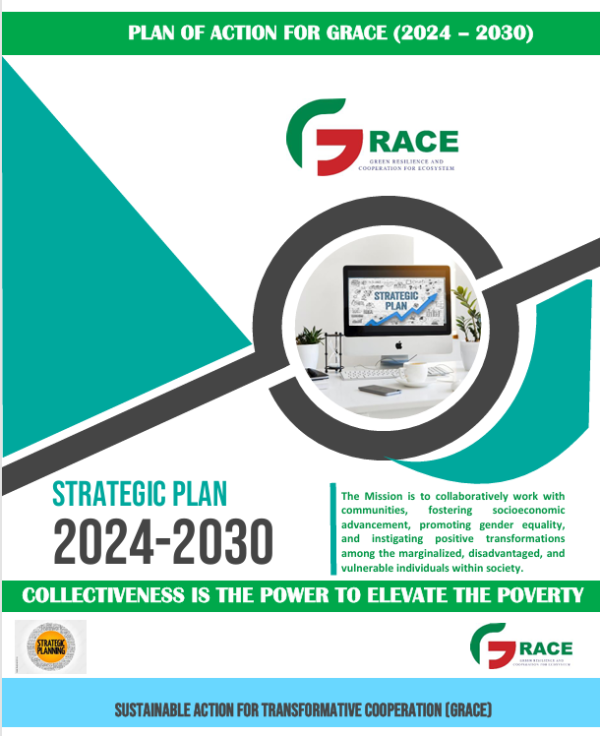
GRACE Strategic Plan 2023–2030 Building Resilient Communities, Enabling Green Futures The GRACE Strategic Plan 2023–2030 guides the organization’s long-term journey toward becoming a credible, inclusive, innovative and sustainable development organization in Bangladesh. The strategy focuses on six interconnected priorities: • Climate Resilience & Environmental Sustainability • Green Livelihoods & Social Entrepreneurship • Green Energy & Nature-Based Solutions • Health, Nutrition & WASH • Education, Skills & Youth Development • Inclusive Governance, Partnerships & Institutional Strengthening GRACE places women, children, youth and climate-vulnerable communities at the centre of its development approach. By strengthening community leadership, innovation, partnerships and evidence-based solutions, GRACE aims to transform local challenges into sustainable opportunities and measurable impact by 2030. Our ambition: Locally rooted, nationally connected and internationally trusted. Link: https://www.gracebd.net/files/publication/GRACE-Strategic-Plan-2024-2030-1789635119.pdf

Read More

Policies

Guiding Policies GRACE considers strong governance, accountability and a rights-based, participatory approach essential to achieving sustainable development. The organization maintains a comprehensive policy framework that guides its governance, programme implementation, financial stewardship, human resource management, safeguarding and institutional accountability. GRACE’s guiding policies ensure transparency, integrity, inclusion, risk management, quality and responsible use of resources, while supporting effective programme delivery and organizational sustainability. Key policies include: Code of Conduct Program Participant Protection & Child Safeguarding Policy Anti-Trafficking in Persons Policy Procurement Policy Information Disclosure Policy Gender Policy Protection from Sexual Exploitation and Abuse (PSEA) Policy Anti-Corruption & Anti-Fraud Management Policy Vehicle Management Policy Travel, Per Diem & Accommodation Policy Core Humanitarian Standard on Quality & Accountability Occupational Health, Safety & Social Environmental Management Policy Emergency Response Procedures Anti-Money Laundering & Counter-Terrorist Financing Policy Share Cost Policy Internal, External & Foreign Audit Policy Foreign Exchange Risk Management Policy Financial Management Policy Human Resource Management Policy These policies are supported by strategic planning, participatory management, staff capacity development, monitoring and learning systems. GRACE also prioritizes institutional networking and collaboration with government agencies, NGOs, INGOs, development partners and other stakeholders to strengthen programme quality, resource mobilization and organizational impact. Together, these systems provide a strong foundation for ethical governance, safeguarding, accountability, quality programming and sustainable institutional growth.

Read More

Accountability

Accountability Transparency • Integrity • Responsibility • Trust GRACE is committed to maintaining high standards of transparency, accountability and ethical practice across its governance, programmes and operations. We promote accountability through clear roles and responsibilities, sound financial management, regular monitoring and reporting, compliance with applicable regulations, and responsible use of donor and organizational resources. GRACE values accountability to communities, partners, donors, staff, volunteers, government and other stakeholders. We encourage participation, feedback and learning to continuously improve the quality, relevance and effectiveness of our work. Our commitment is to ensure that every programme and resource contributes to measurable, inclusive and sustainable impact, while maintaining integrity, safeguarding and respect for the people and communities we serve.

Read More

Project Management Board

The Project Management Board guides project planning, execution, and monitoring. It ensures timely delivery, coordination, and alignment with organizational goals.

Read More

Our Partners

People's Republic of Bangladesh
Department of Social Service
People's Republic of Bangladesh
Department of Social Service
People's Republic of Bangladesh
Department of Social Service