

GRACE MEAL FRAMEWORK
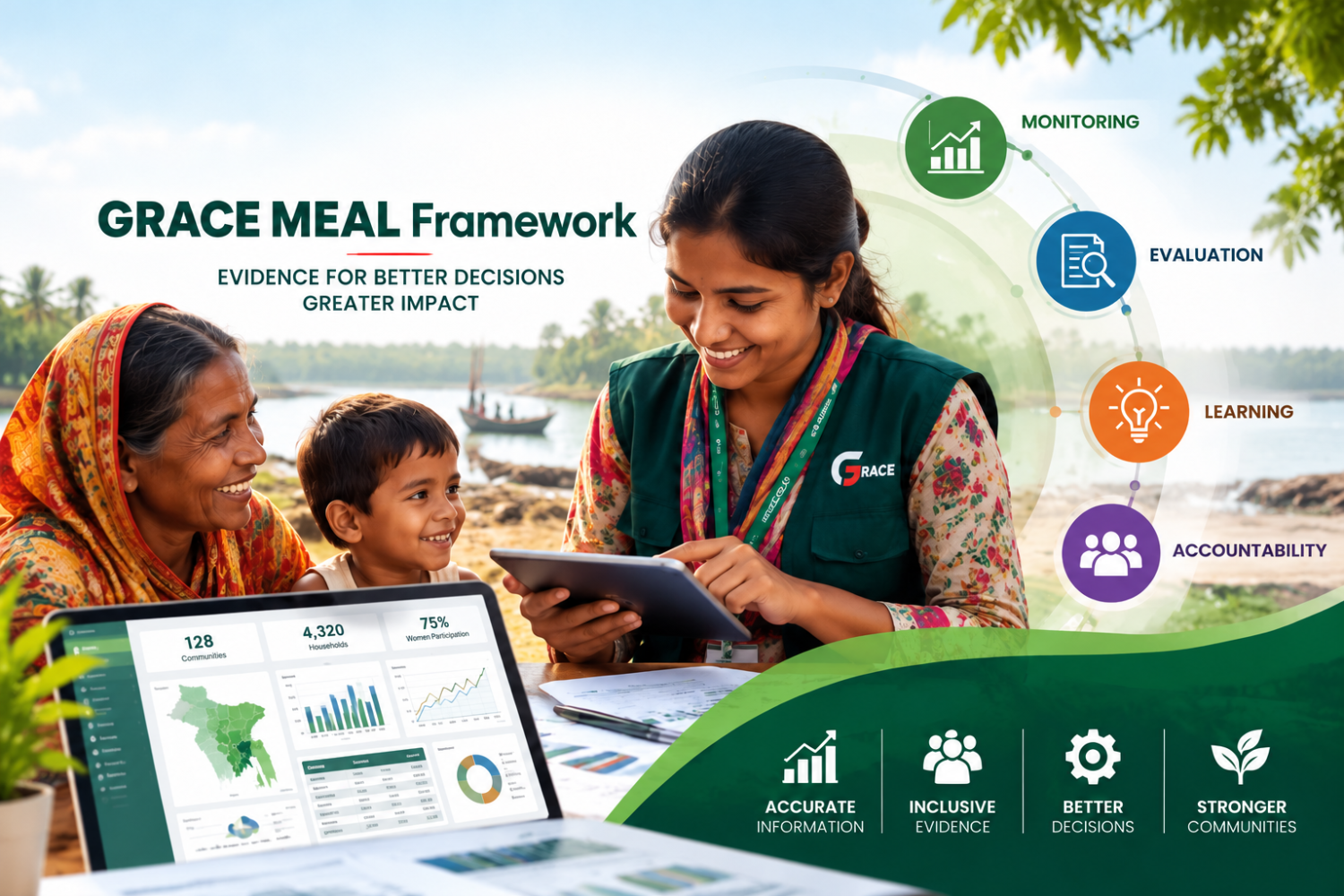

Strengthening Evidence-Based, Accountable and Learning-Oriented Development
Monitoring, Evaluation, Accountability and Learning (MEAL)
Framework
Strengthening
Evidence-Based, Accountable and Learning-Oriented Development
GRACE is committed to delivering effective, transparent and
sustainable development programmes through a robust Monitoring, Evaluation,
Accountability and Learning (MEAL) system. Our MEAL framework ensures that
every intervention is guided by evidence, community voices, measurable results
and continuous learning.
Since 2013, GRACE has applied participatory and data-driven
approaches to monitor programme performance, measure outcomes, strengthen
accountability and improve the quality of services for women, children, youth
and climate-vulnerable communities in coastal Bangladesh.
Our
MEAL Approach
GRACE’s
MEAL system integrates four key pillars:
1.
Monitoring: Tracking Progress and Results
GRACE regularly monitors programme activities, outputs and
outcomes using systematic tools and processes. Monitoring helps us assess
progress against planned objectives, identify challenges and ensure effective
implementation.
Key
practices include:
- Regular field monitoring visits
- Indicator-based tracking
- Project performance reviews
- Digital data management systems
- Programme quality assessments
2.
Evaluation: Measuring Impact and Effectiveness
GRACE
conducts structured evaluations to understand programme effectiveness,
sustainability and long-term impact.
Our
evaluation processes include:
- Baseline assessments
- Mid-term evaluations
- Final evaluations
- Impact assessments where
appropriate
Evaluation
findings support evidence-based decision-making and future programme design.
3.
Accountability: Listening and Responding to Communities
GRACE
places communities at the centre of its accountability approach. We promote
transparency, participation and feedback mechanisms to ensure that community
perspectives influence programme decisions.
Our
accountability mechanisms include:
- Community feedback systems
- Complaint and Response Mechanism
(CRM/CFRM)
- Stakeholder consultations
- Beneficiary satisfaction
assessments
- Safeguarding and ethical
standards
4.
Learning: Improving Through Evidence and Experience
GRACE
promotes a culture of continuous learning by capturing experiences, documenting
good practices and applying lessons to strengthen future programmes.
Learning
approaches include:
- Quarterly learning reviews
- After Action Reviews (AAR)
- Case studies and success stories
- Knowledge-sharing sessions
- Learning briefs and documentation
Digital
MEAL Management System
GRACE
has developed a digitalized MEAL management system to strengthen data
collection, analysis and reporting.
The
digital MEAL dashboard enables:
- Real-time project monitoring
- Indicator tracking
- Data visualization
- Evidence-based reporting
- Project-level performance
analysis
- Management decision support
This
system enhances efficiency, transparency and accountability across all
programmes.
MEAL
Governance Structure
GRACE’s
MEAL system operates through a clear organizational structure:
Governance
Board
→ Strategic oversight and accountability
Executive
Director
→ Overall MEAL leadership and organizational commitment
Programme
Director
→ Programme quality assurance
MEAL
Coordinator
→ System management, reporting and data quality
Programme
Teams
→ Field monitoring and data collection
Community
Representatives
→ Feedback, validation and community participation
Our
Commitment
Through
a strong MEAL framework, GRACE ensures that programmes are:
✓ Evidence-based
✓
Community-centred
✓ Transparent and
accountable
✓ Results-oriented
✓ Continuously
improved through learning
GRACE
believes that effective MEAL is not only about measuring results—it is about creating
meaningful change, strengthening accountability and ensuring sustainable impact
for vulnerable communities.
Download
Full MEAL Framework
Download PDF
Building Bonding and Belonging together
Explore further

Our Partners